Shell (Default)¶
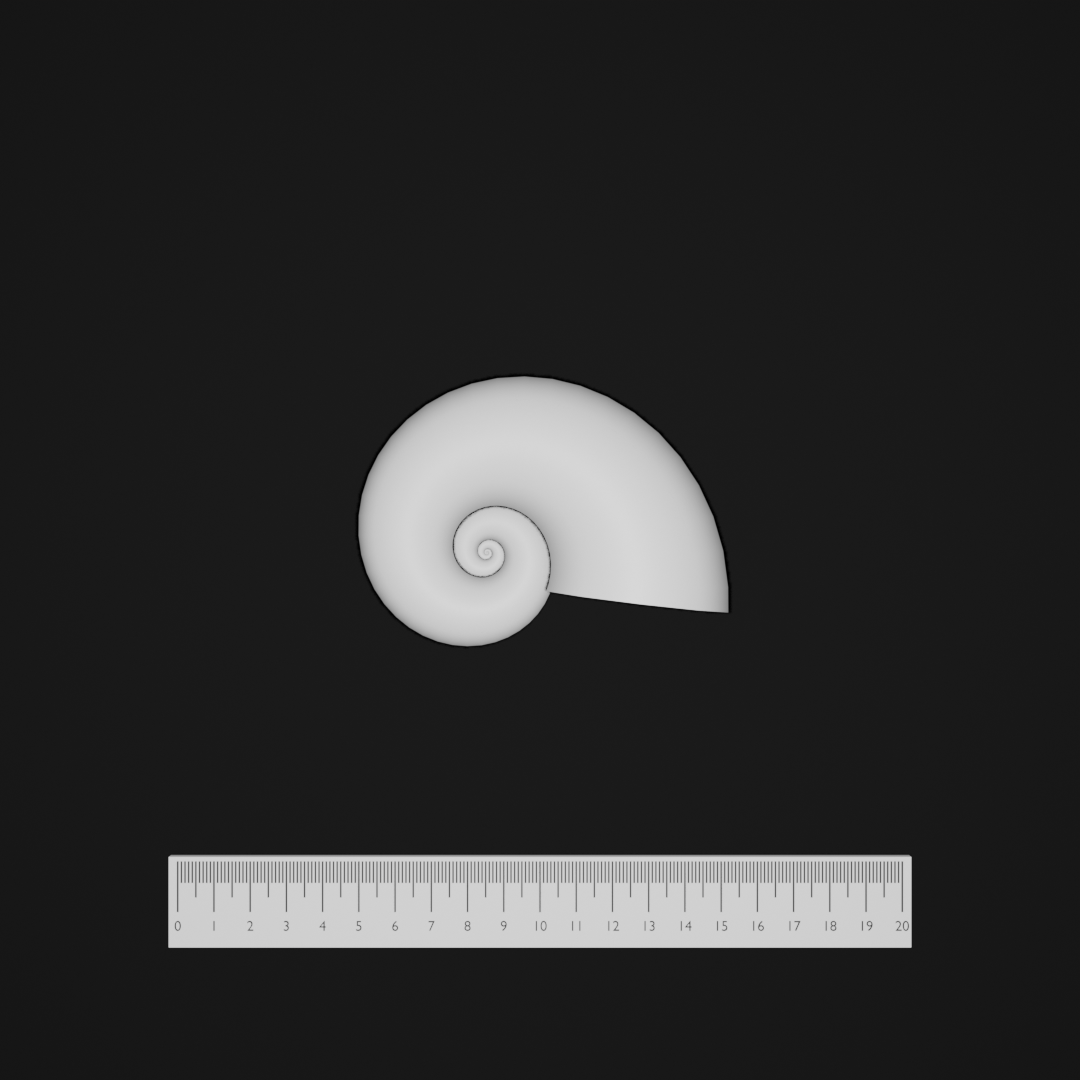
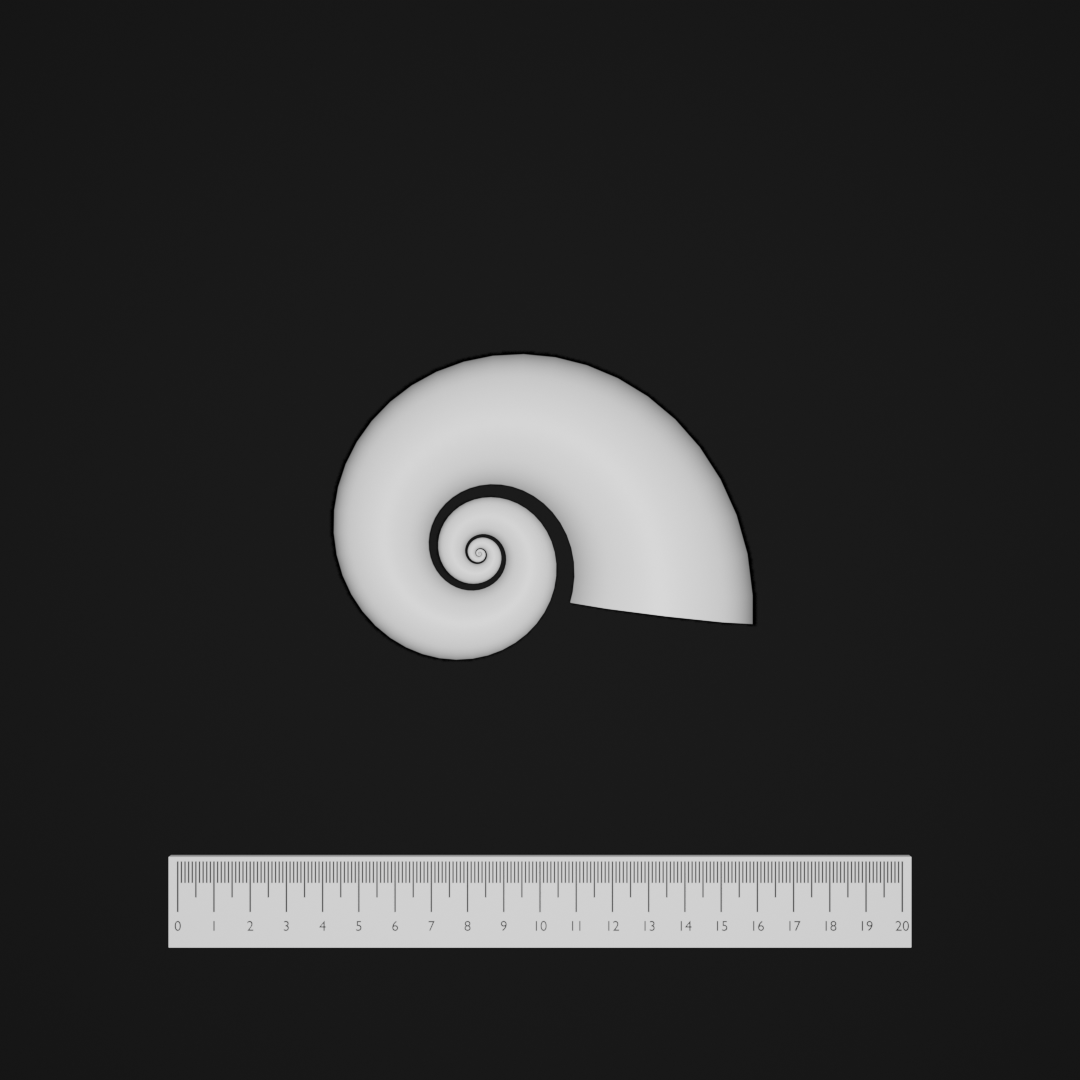
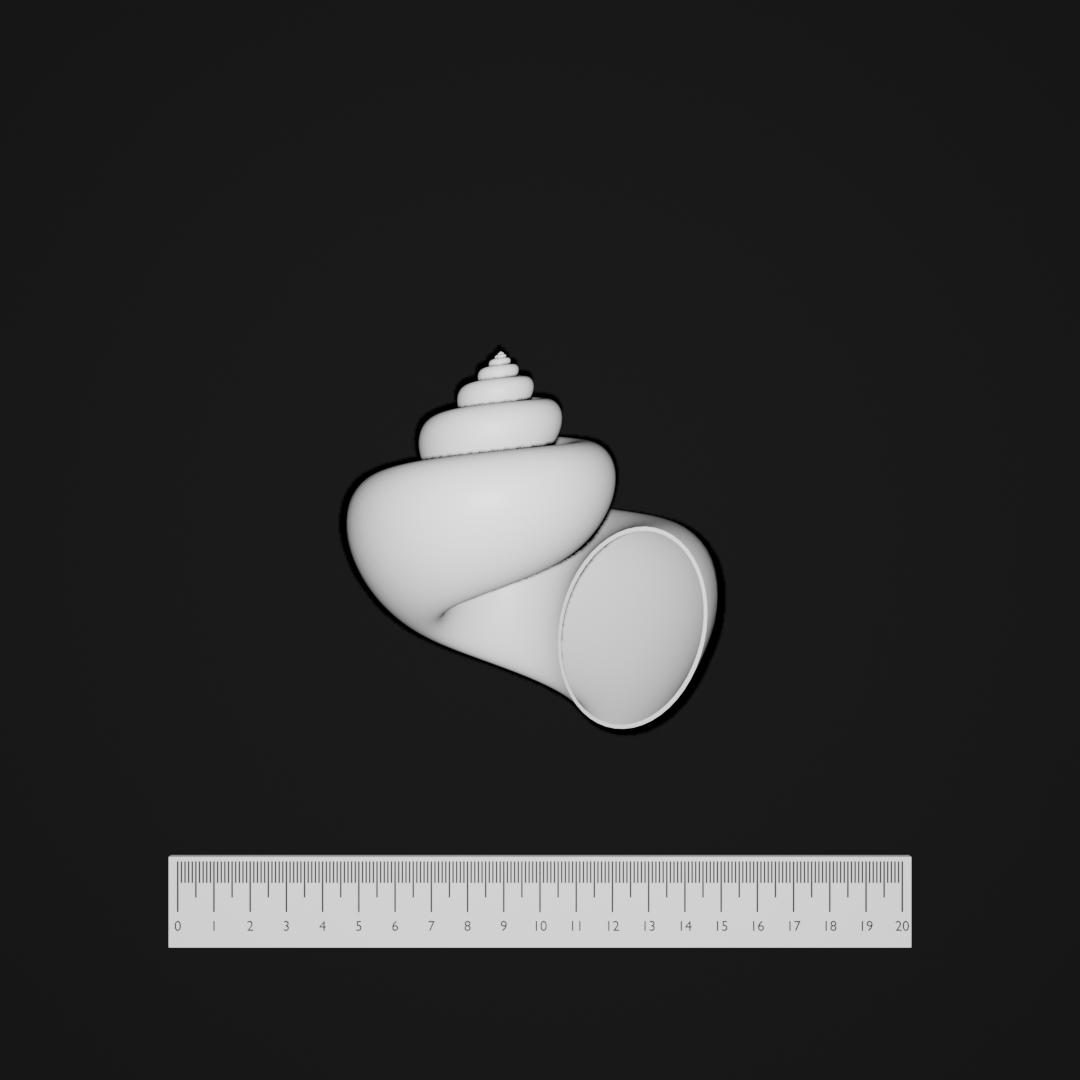
The Shell (Default) morphospace generates 3D shells from a parametric model of coiling geometry Contreras-Figueroa & Aragón (2023), with thickness allometry following Okabe & Yoshimura (2017).
Traits (dataset columns)¶
These correspond to arguments of sample() (excluding name and hyperparameters).
In the paper, most of them control the coiling geometry and aperture shape along the growth axis.
| Trait name | Default | Description | Range (paper) |
|---|---|---|---|
b |
0.2 |
Whorl expansion rate. How fast the spiral and generating curve of the shell expand. | 0 ≤ b < ∞. b = 0 → torus; b → ∞ → straight shell. |
d |
1.65 |
Horizontal distance from the spiral to the coiling axis. | 0 < d < ∞. d → ∞ → infinitely expanded shell. |
z |
0 |
Vertical translation of the spiral (vertical distance to the x–y plane). | −∞ < z < ∞. Dextral: z > 0; sinistral: z < 0; planispiral: z = 0. |
a |
1 |
Ratio of major to minor axes of the ellipse modeling the aperture. | 0 < a < ∞. Narrow: a < 1; circular: a = 1; wide: a > 1. |
phi |
0 |
Initial tilt angle of the aperture before it is placed in the Frenet frame. | 0 ≤ φ < π. |
psi |
0 |
Rotation angle around the binormal axis in the local Frenet frame. | 0 ≤ ψ < π/2 to avoid invagination. |
k |
0 |
Aperture displacement along the binormal in generating-curve units (Contreras §2.7.3). Shifts the whole generating curve before the ψ rotation. Positive = right valve; negative = left valve. | 0 for most coiled shells; valve-like forms often ≠ 0. |
c_depth |
0 |
Axial ribbing amplitude on the outer surface. Scales the generating curve by 1 + c_depth(1 + sin(c_n t)); rib troughs sit on the unribbed outer profile, peaks extend outward. |
0 = no axial ribs. |
c_n |
70 |
Axial ribbing frequency. Number of axial rib cycles per 2π radians of growth (parameter t). |
≥ 0; e.g. 70 ≈ 70 rib cycles per full turn of the spiral. |
n_depth |
0 |
Spiral ribbing amplitude on the outer surface. Scales the generating curve by 1 + n_depth(1 + sin(n θ)); rib troughs sit on the unribbed outer profile, peaks extend outward. |
0 = no spiral ribs. |
n |
0 |
Spiral ribbing frequency. Number of rib cycles around the aperture circumference (parameter θ). | ≥ 0; e.g. 0, 4, 8, 12. |
t |
100 |
End of the growth interval in the parametric curve (growth parameter in radians). | Positive; larger values = more whorls (one whorl ≈ 2π radians). |
eps |
0.8 |
Thickness allometry exponent (ε). Wall thickness scales as (aperture size)^eps. eps = 1 is isometric (thickness ∝ size); eps < 1 is allometric (thickness grows more slowly than aperture size, as in many ammonoids). | 0 = constant thickness; 1 = isometric; < 1 typical for real shells (e.g. ≈ 0.8). |
h_0 |
0.1 |
Reference thickness. Scale factor in the thickness formula: thickness = (aperture size)^eps × h_0. | Small positive (e.g. 0.01–0.3). |
S |
5.0 |
Target final aperture diameter (cm) measured parallel to the local binormal direction; sets global physical scale from that axis. Based on the unribbed generating curve. | > 0. |
Note. When global scaling by S is enabled, parameters estimated from Contreras-Figueroa & Aragón (2023) must be converted to TraitBlender units by dividing by
The factor 200 combines the aperture-diameter factor of 2 with 100 to convert S from centimeters to meters (Blender's native length unit). Only d, z, h_0, and k require this correction; all other parameters are dimensionless and require none.
Ribbing and wall thickness¶
Ribbing applies to the outer surface only. Axial and spiral rib factors multiply on the outer generating curve:
- Axial:
1 + c_depth(1 + sin(c_n t)) - Spiral:
1 + n_depth(1 + sin(n θ))
At each sine minimum (sin = −1), the rib factor is 1, so the outer profile matches the unribbed shell. At sine maxima, the outer wall extends beyond that baseline. Setting a depth amplitude to 0 disables that rib type.
Wall thickness (Okabe & Yoshimura) is computed from the smooth, unribbed generating curve and is not modulated by ribbing; ribs add outward displacement on top of that baseline thickness.
Global scaling (S) is likewise based on the unribbed final aperture diameter in the binormal direction; rib peaks can exceed that target size.
Hyperparameters (configuration)¶
These live under the morphospace.hyperparams section in the config file.
| Hyperparameter | Default | Description | Typical range / notes |
|---|---|---|---|
n_vertices_aperture |
20 |
Number of points around each aperture ring (mesh resolution). | Integers ~12–64. Higher = smoother but heavier. |
time_step |
0.05 |
Step size for the growth parameter t. |
Positive; smaller = more segments (smoother shells). |
use_inner_surface |
false |
Whether to generate an inner surface with wall thickness. | Enable when you need closed/thick shells for meshes. |
To change these hyperparameters, edit the YAML:
morphospace:
  name: Shell (Default)
  hyperparams:
    n_vertices_aperture: 24
    time_step: 0.03
    use_inner_surface: true
Orientations¶
Shell defines built-in named orientations (including Default) for placing specimens on the table. You can also define custom Euler orientations that work with Shell (and every other morphospace) in the Orientations panel or under imaging.custom_orientations in YAML — see Morphospaces overview and Configuration Files.
References¶
- Contreras-Figueroa, G. & Aragón, J. L. (2023). A mathematical model for mollusc shells based on parametric surfaces and the construction of theoretical morphospaces. Diversity 15, 431. https://doi.org/10.3390/d15030431
- Okabe, T. & Yoshimura, J. (2017). Optimal designs of mollusk shells from bivalves to snails. Scientific Reports 7, 42445. https://doi.org/10.1038/srep42445