Research Papers

Publications and preprints from the BioCLIP project. Explore the foundational research behind our vision models for the Tree of Life.

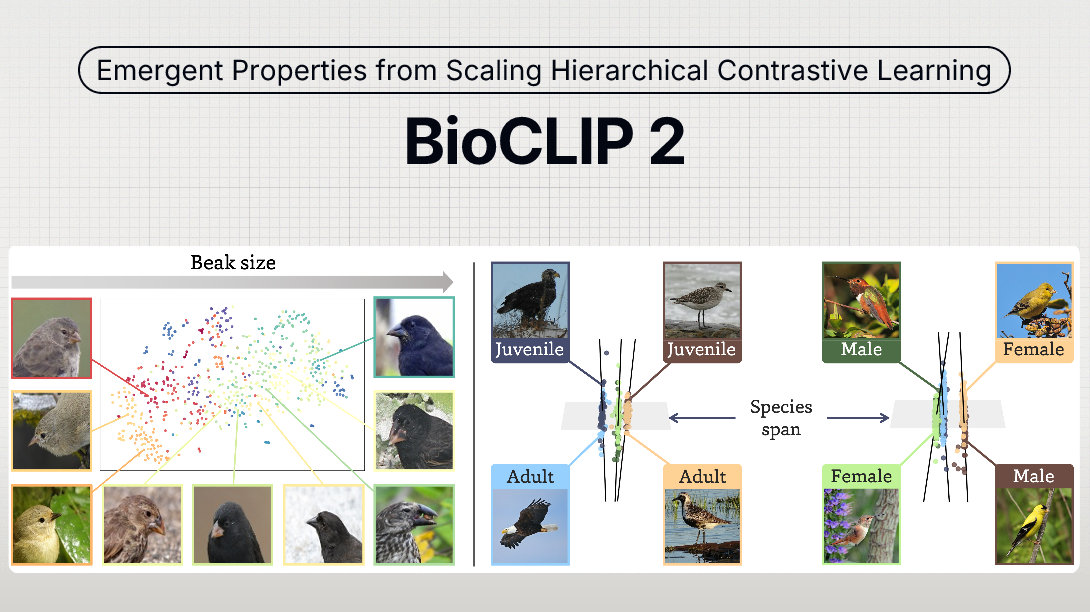
BioCLIP 2 architecture and embedding visualization
NeurIPS 2025

BioCLIP 2: Emergent Properties from Scaling Hierarchical Contrastive Learning

Jianyang Gu, Samuel Stevens, Elizabeth G Campolongo, Matthew J Thompson, Net Zhang, Jiaman Wu, Andrei Kopanev, Zheda Mai, Alexander E. White, James Balhoff, Wasila Dahdul, Daniel Rubenstein, Hilmar Lapp, Tanya Berger-Wolf, Wei-Lun Chao, Yu Su

Foundation models trained at scale exhibit remarkable emergent behaviors, learning new capabilities beyond their initial training objectives. We find such emergent behaviors in biological vision models via large-scale contrastive vision-language training. To achieve this, we first curate TreeOfLife-200M, comprising 214 million images of living organisms, the largest and most diverse biological organism image dataset to date. We then train BioCLIP 2 on TreeOfLife-200M to distinguish different species. Despite the narrow training objective, BioCLIP 2 yields extraordinary accuracy when applied to various biological visual tasks such as habitat classification and trait prediction. We identify emergent properties in the learned embedding space of BioCLIP 2. At the inter-species level, the embedding distribution of different species aligns closely with functional and ecological meanings (e.g., beak sizes and habitats). At the intra-species level, instead of being diminished, the intra-species variations (e.g., life stages and sexes) are preserved and better separated in subspaces orthogonal to inter-species distinctions. We provide formal proof and analyses to explain why hierarchical supervision and contrastive objectives encourage these emergent properties. Crucially, our results reveal that these properties become increasingly significant with larger-scale training data, leading to a biologically meaningful embedding space.
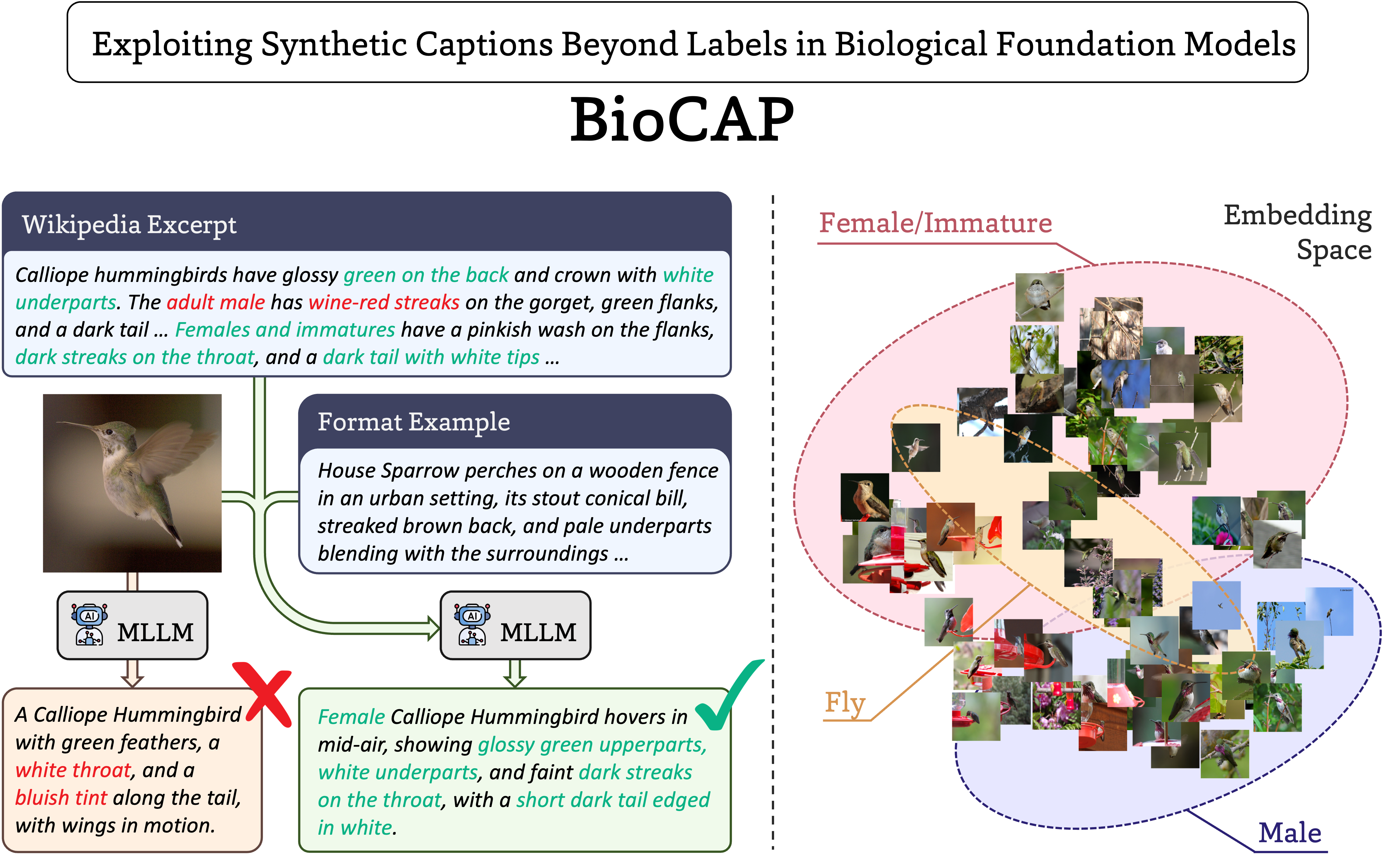
BioCAP caption generation visualization
ICLR 2026

BioCAP: Exploiting Synthetic Captions Beyond Labels in Biological Foundation Models

Ziheng Zhang, Xinyue Ma, Arpita Chowdhury, Elizabeth G. Campolongo, Matthew J. Thompson, Net Zhang, Samuel Stevens, Hilmar Lapp, Tanya Berger-Wolf, Yu Su, Wei-Lun Chao, Jianyang Gu

This work investigates descriptive captions as an additional source of supervision for biological multimodal foundation models. Images and captions can be viewed as complementary samples from the latent morphospace of a species, each capturing certain biological traits. Incorporating captions during training encourages alignment with this shared latent structure, emphasizing potentially diagnostic characters while suppressing spurious correlations. The main challenge, however, lies in obtaining faithful, instance-specific captions at scale. This requirement has limited the utilization of natural language supervision in organismal biology compared with many other scientific domains. We complement this gap by generating synthetic captions with multimodal large language models (MLLMs), guided by Wikipedia-derived visual information and taxon-tailored format examples. These domain-specific contexts help reduce hallucination and yield accurate, instance-based descriptive captions. Using these captions, we train BioCAP (i.e., BioCLIP with Captions), a biological foundation model that captures rich semantics and achieves strong performance in species classification and text-image retrieval. These results demonstrate the value of descriptive captions beyond labels in bridging biological images with multimodal foundation models.

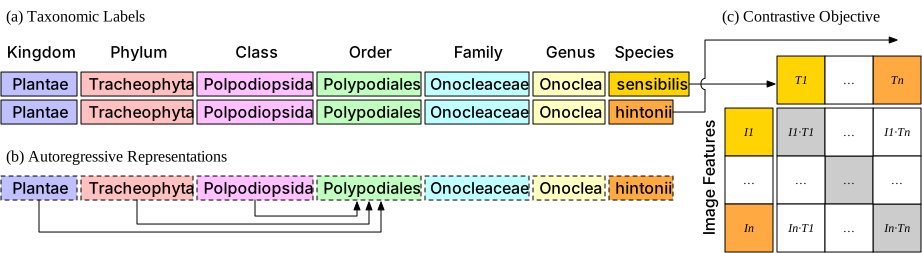
BioCLIP model architecture
CVPR 2024

BioCLIP: A Vision Foundation Model for the Tree of Life

Samuel Stevens, Jiaman Wu, Matthew J Thompson, Elizabeth G Campolongo, Chan Hee Song, David Edward Carlyn, Li Dong, Wasila M Dahdul, Charles Stewart, Tanya Berger-Wolf, Wei-Lun Chao, Yu Su

Images of the natural world collected by a variety of cameras from drones to individual phones are increasingly abundant sources of biological information. There is an explosion of computational methods and tools particularly computer vision for extracting biologically relevant information from images for science and conservation. Yet most of these are bespoke approaches designed for a specific task and are not easily adaptable or extendable to new questions contexts and datasets. A vision model for general organismal biology questions on images is of timely need. To approach this we curate and release TreeOfLife-10M the largest and most diverse ML-ready dataset of biology images. We then develop BioCLIP a foundation model for the tree of life leveraging the unique properties of biology captured by TreeOfLife-10M namely the abundance and variety of images of plants animals and fungi together with the availability of rich structured biological knowledge. We rigorously benchmark our approach on diverse fine-grained biology classification tasks and find that BioCLIP consistently and substantially outperforms existing baselines (by 17% to 20% absolute). Intrinsic evaluation reveals that BioCLIP has learned a hierarchical representation conforming to the tree of life shedding light on its strong generalizability. All data code and models will be publicly released upon acceptance.