Bridging computer vision and biology. BioCLIP models learn hierarchical representations of the natural world, enabling advanced species classification, trait prediction, and more.
I need the latest model with the highest accuracy (ViT-H) and emergent biological capabilities. Speed and size are not an issue.
Go to BioCLIP 2.5 Huge →I have inference speed or size constraints, but need the latest model with the highest accuracy (ViT-L) and emergent biological capabilities.
Go to BioCLIP 2 →I need a ViT-B/16 model for inference speed or direct comparison; looking for base model trained with captions and taxonomic labels.
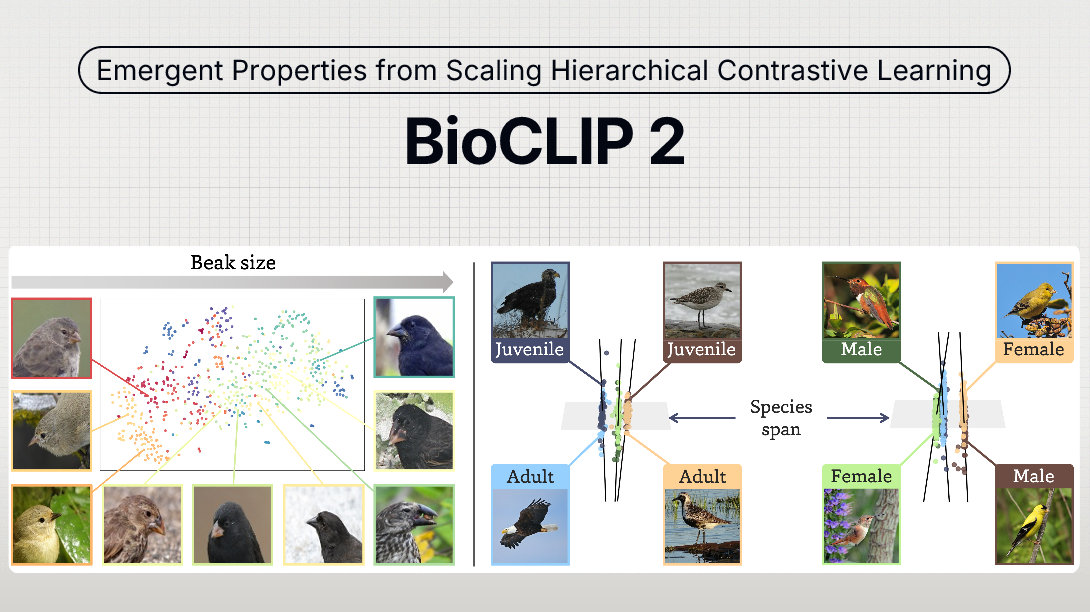
Go to BioCAP →The largest model in the BioCLIP collection, BioCLIP 2.5 Huge was trained on 233-million images across more than 950-thousand taxa. Training was accelerated through an updated version of the BioCLIP 2 repository (v2.0.0). BioCLIP 2.5 exhibits emergent properties, extending beyond simple classification, to distinguish between life stages, sexes, and align embeddings with ecological traits like beak size.
The model achieves new state-of-the-art performance on both species classification and broader biological visual tasks, surpassing BioCLIP 2 by 5.7% and 3.5%, respectively. Especially in FishNet, which requires the model to distinguish different habitats, BioCLIP 2.5 Huge demonstrates a 8.7% performance improvement over BioCLIP 2.
The next generation model, BioCLIP 2 was trained on 214-million images across more than 950-thousand taxa. It outperforms BioCLIP by 18.0% and provides a 30.1% improvement over the CLIP (ViT-L/14) model used as weight initialization.
Beyond simple classification, it exhibits emergent properties, such as distinguishing between life stages, sexes, and aligning embeddings with ecological traits like beak size.
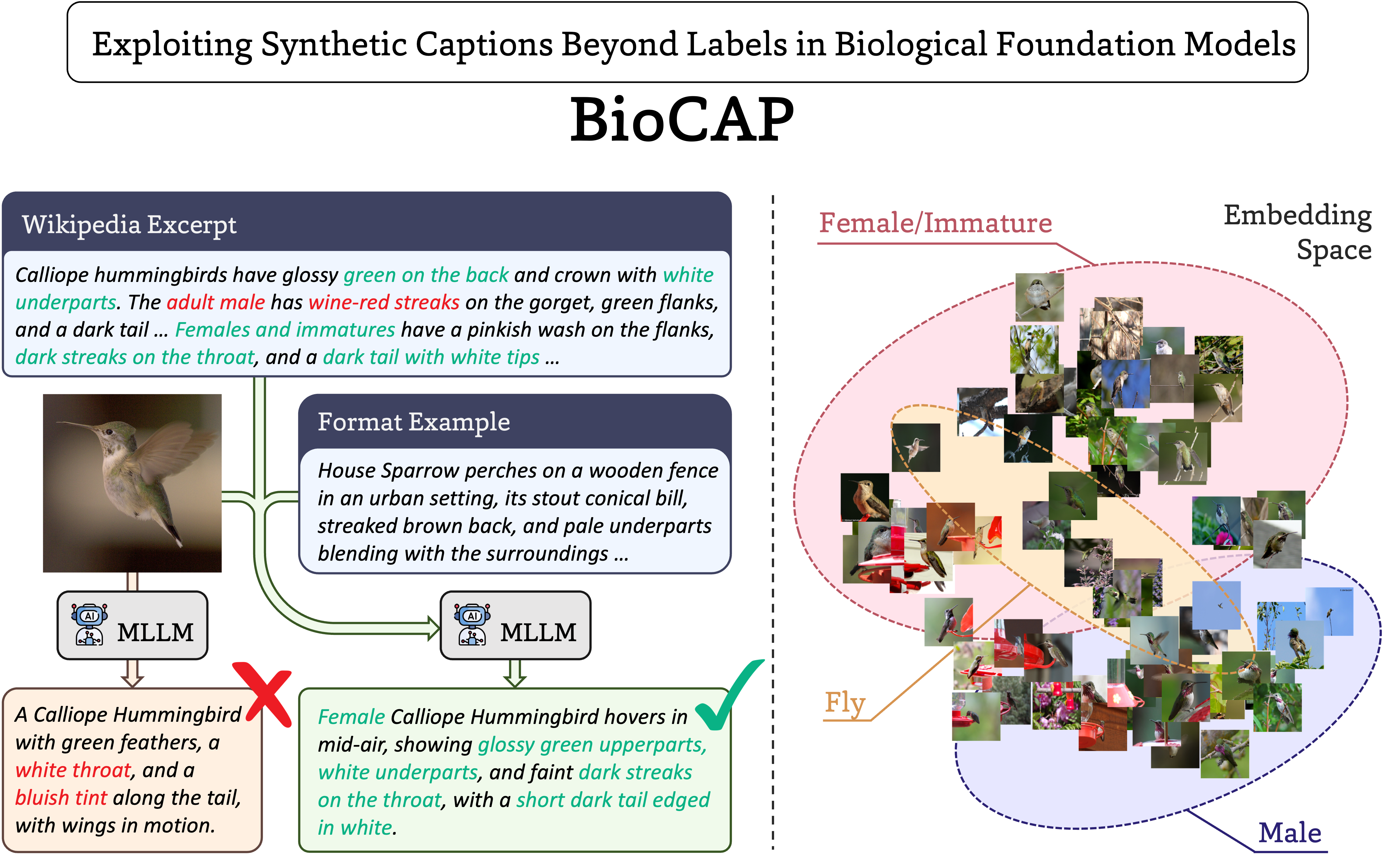
BioCAP introduces descriptive captions to the original BioCLIP training regimen as complementary supervision, aligning visual and textual representations within the latent morphospace of species. This added context improves performance by +8.8% on classification and +21.3% on retrieval, demonstrating that descriptive language enriches biological foundation models beyond labels.
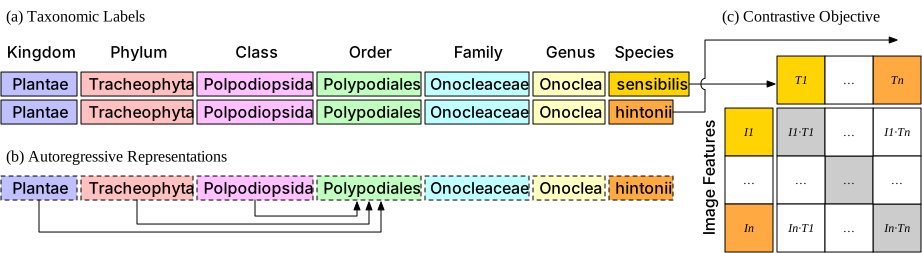
Trained on the TreeOfLife-10M dataset paired with TreeOfLife-10M Captions, providing synthetic, trait-rich captions generated based on morphological context and taxon-specific examples, it covers over 390,000 taxa and learns a hierarchical representation that aligns with the biological taxonomy.
The original foundation model presented in "BioCLIP: A Vision Foundation Model for the Tree of Life". It established the standard for using CLIP architectures in organismal biology.
Trained on the TreeOfLife-10M dataset, it covers over 450,000 taxa and learns a hierarchical representation that aligns with the biological taxonomy.
The central warehouse for all BioCLIP assets. This collection aggregates all versions of the models, the training datasets, benchmarks, and interactive demos.
Use this if you need direct access to raw model weights (SafeTensors/PyTorch), want to access the TreeOfLife or benchmark datasets, or are looking for easy by-image predictions.